
Modern air operations no longer start and end in the air domain.
An aircraft executing a precision strike may depend on GNSS for navigation, satellite communications for connectivity, space-based ISR for target information, terrestrial and airborne sensors for situational awareness, and a distributed Command and Control architecture to coordinate the mission.
At the same time, every element of this chain may be contested.
This is the operational environment NATO Allied Command Transformation described in August 2026 when analysing the evolution of Allied Air and Space Power.
The conflict in Ukraine has demonstrated how inexpensive unmanned systems, long-range precision weapons, Electronic Warfare and increasingly sophisticated missile threats are compressing decision timelines. At the same time, military operations have become increasingly dependent on space-based capabilities.
The result is a fundamental change in the operational problem.
The question is no longer simply whether a platform, radar, interceptor or satellite performs according to specification.
The real question is:
What happens to the mission when several elements of the system are degraded simultaneously?
THE SCENARIO
Consider a Joint Force conducting an air operation inside a contested environment.
The operational architecture includes:
- space-based ISR assets
- SATCOM
- GNSS/PNT services
- airborne ISR
- ground and naval surveillance radars
- Integrated Air and Missile Defence systems
- fighter aircraft
- long-range effectors
- unmanned platforms
- Command and Control nodes
- tactical and strategic data links
Now introduce adversarial effects.
GNSS accuracy begins to degrade.
SATCOM availability becomes intermittent.
Part of the electromagnetic spectrum is heavily contested.
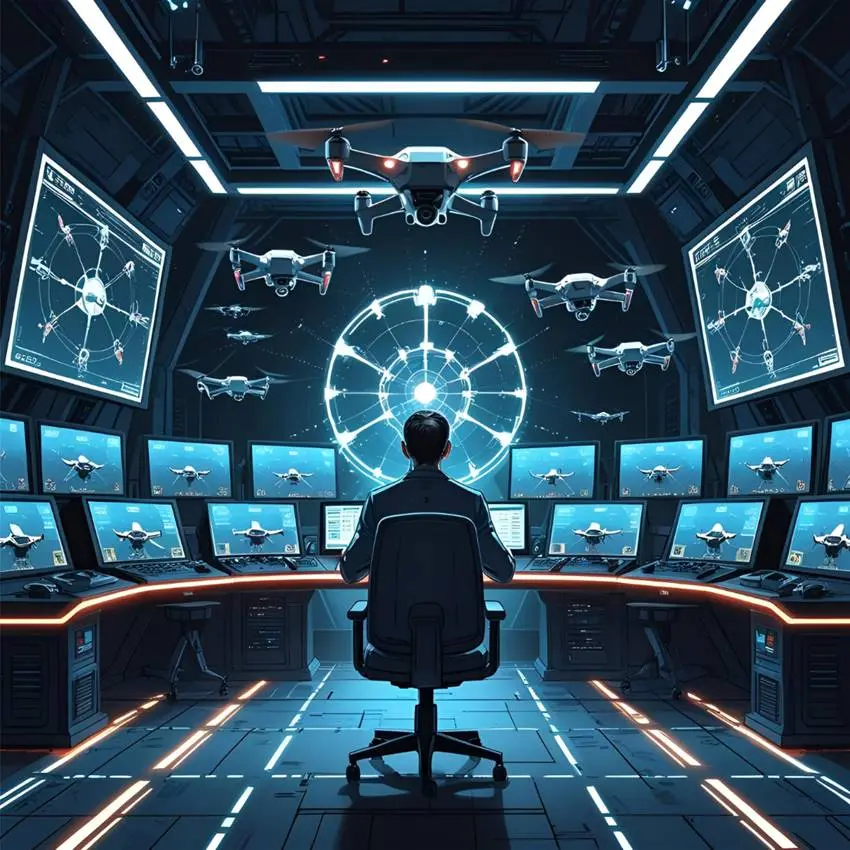
An adversary deploys large numbers of low-cost UAS alongside conventional air threats.
Long-range missiles approach through different trajectories.
Some ISR assets continue to operate, while others provide incomplete or delayed information.
Commanders are now operating with a partial and continuously changing picture of the battlespace.
This is where Modeling & Simulation becomes an operational capability rather than an engineering support function.
FROM PLATFORM PERFORMANCE TO MISSION PERFORMANCE
Traditional analysis often evaluates individual systems.
Radar detection range.
Interceptor probability of kill.
Satellite revisit time.
Communication link availability.
Aircraft endurance.
Sensor accuracy.
Each metric remains important.
But Multi-Domain Operations require another level of analysis: the interaction between those systems.
A degradation affecting one domain may generate operational consequences across several others.
A loss of GNSS availability, for example, is not merely a navigation problem.
Depending on the architecture, the same event may influence:
target geolocation accuracy,
weapon effectiveness,
UAS navigation,
force synchronization,
sensor correlation,
timing,
and ultimately the Commander’s decision cycle.
Modeling & Simulation allows these dependencies to be represented within the same operational scenario.
The object being analysed is no longer the platform.
The object becomes the mission.
MODELING THE CONTESTED ENVIRONMENT
A credible Multi-Domain simulation must therefore reproduce both friendly capabilities and adversarial effects.
The electromagnetic environment becomes a dynamic component of the scenario.
Communication links should not simply exist or disappear. Their latency, availability, capacity and resilience should change according to geometry, interference, network configuration and adversarial action.
The same applies to PNT.
Instead of assuming continuous GNSS availability, planners should evaluate different degradation conditions and measure their impact across the entire mission architecture.
Space assets must also become active elements of the simulation.
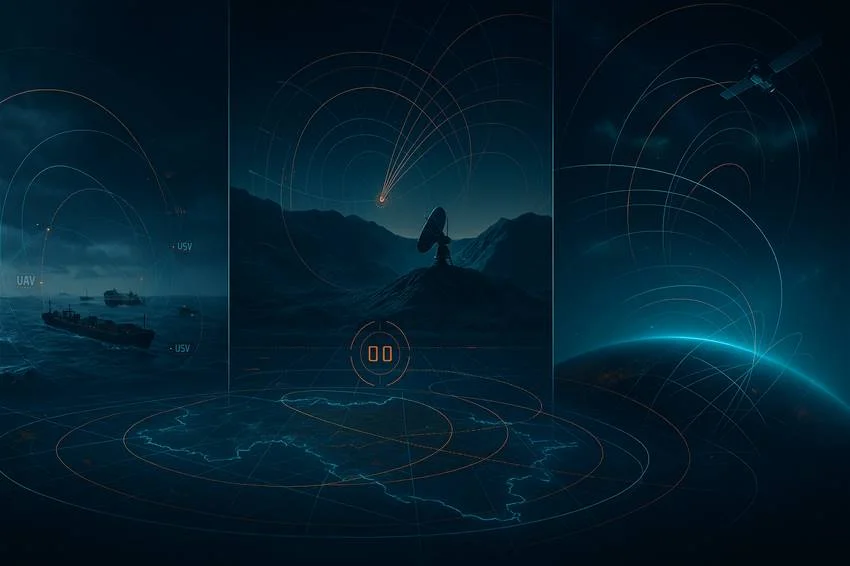
Orbital geometry determines when ISR assets provide coverage.
Satellite visibility influences communication availability.
Missile warning systems affect reaction time.
Space-based sensors contribute to the recognized operational picture.
An adversarial action against one of these services therefore changes the conditions under which forces in the air, land and maritime domains operate.
COMPRESSED DECISION TIMELINES
The proliferation of UAS, cruise missiles and highly manoeuvrable threats creates another major problem: time.
A modern Integrated Air and Missile Defence architecture may receive information from multiple sensors operating across different domains.
The problem is not simply detecting the threat.
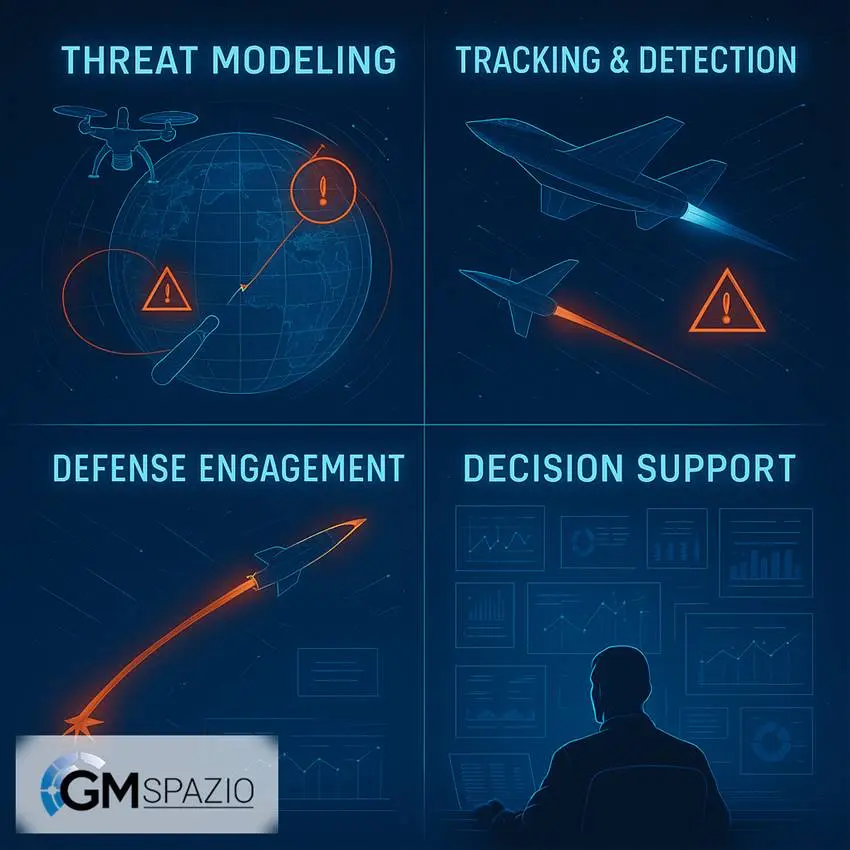
The system must detect, classify, correlate, prioritize and assign an appropriate effector before the engagement window closes.
Simulation allows analysts to measure this complete kill chain.
Detect.
Track.
Identify.
Decide.
Engage.
Assess.
Every delay matters.
A few seconds added during sensor fusion or C2 processing may change whether an interceptor reaches its engagement envelope.
Modeling therefore allows commanders and system architects to investigate where the operational architecture starts to fail before the failure occurs in reality.
TESTING FAILURE, NOT ONLY SUCCESS
One of the most valuable applications of Modeling & Simulation is the ability to deliberately break the operational architecture.
What happens if a satellite communication channel becomes unavailable?
What happens if GNSS accuracy deteriorates?
What happens when the primary radar is jammed?
What happens if the number of incoming targets exceeds the tracking capacity of one sensor?
What happens when command connectivity between two nodes is lost?
What happens when the highest-performance interceptor has already been allocated to another threat?
A simulation environment allows hundreds or thousands of these combinations to be explored without consuming operational assets.
Monte Carlo analysis then moves the discussion beyond a single deterministic scenario.
Instead of asking whether a mission works, decision makers can evaluate how frequently the mission succeeds and which variables drive the outcome.
This provides something far more relevant to operational planning:
a quantitative understanding of mission resilience.
THE DIGITAL REPRESENTATION OF THE BATTLESPACE
For Multi-Domain Operations, the highest value comes from connecting models.
Air.
Space.
Land.
Maritime.
Cyber.
Electromagnetic spectrum.
Sensors.
Weapons.
Networks.
Command and Control.
The resulting synthetic environment allows operational planners to analyse interactions which are difficult, expensive or impossible to reproduce during live exercises.
Different force packages can be compared.
Alternative sensor deployments can be evaluated.
Satellite coverage can be modified.
Communication architectures can be stressed.
Interceptor allocation policies can be tested.
Rules of engagement can be changed.
Adversary behaviour can be varied.
The same operational scenario can then be executed repeatedly under different assumptions.
This turns simulation into an experimental environment for operational decision making.
FROM LESSONS LEARNED TO TESTABLE HYPOTHESES
Recent conflicts provide enormous quantities of operational observations.
But observations from one conflict should not automatically become requirements for the next.
Terrain changes.
Force structures change.
Sensors change.
Threats change.
Doctrine changes.
Operational constraints change.
NATO’s Future Force Study addresses exactly this problem by translating observations into hypotheses and stress-testing them through analysis, wargaming and Modeling & Simulation.
This distinction is critical.
A lesson learned describes what happened.
A model allows us to ask whether the same outcome would occur under different conditions.
That difference transforms battlefield experience into evidence for force design.
MODEL BEFORE YOU DEPLOY
Multi-Domain Warfare increasingly depends on interconnected systems operating under uncertainty.
Every additional connection creates operational opportunities, but also dependencies.
Space capabilities support aircraft.
Aircraft support ground forces.
Ground and naval sensors contribute to air defence.
Networks connect sensors with effectors.
The electromagnetic spectrum supports almost every part of the architecture.
The effectiveness of the force therefore depends less on the theoretical performance of an individual platform and more on the behaviour of the complete system under operational stress.
This is the role of Modeling & Simulation.
To reproduce the battlespace before entering the battlespace.
To expose dependencies before an adversary exploits them.
To evaluate alternatives before committing resources.
And above all, to understand whether a force remains operational when the assumptions on which the mission was built begin to fail.